Boundaries: Healthy Fences, Healthy Relationships

by Natalie Holmyard
Boundaries: Healthy Fences, Healthy Relationships
Following on from last month’s Bulletin on Boundaries – Loads and Burdens, I would like to share a little more about boundaries in regard to our Loads - in our own Garden.
The concept of our own “garden” (labelling our relationships and our work in those relationships) comes from our beloved Dennis, from the Living Life God’s Way Series. Thank you, beloved Dennis.
Our “garden” needs to be both well-defined and intentionally cared for. A healthy “garden” doesn't thrive by accident - it flourishes because its boundaries are clear, protected, and respected.
A healthy “garden” is really about boundaries. Boundaries help us understand where we begin and where we end. In the physical world, a fence, wall, or hedge marks the edges of a property. It lets others know what belongs inside and what lies beyond.
In our spiritual, emotional, and relational lives, however, our "fences" are invisible. Even though they can't be seen, they are no less important. We can establish healthy boundaries, but before we communicate them to others, we first need to know them ourselves. Understanding our own convictions, values, limits, and responsibilities is foundational.
One of the simplest expressions of healthy boundaries is being clear about our "yes" and our "no". This is boundary setting 101. Jesus Himself taught that our "yes" should mean yes, and our "no" should mean no. Throughout Scripture, we also see God modelling clear boundaries. He is never vague about what He will do or what He will not do.
There are times when "no" is not only appropriate but deeply biblical.
"No, that behaviour is not acceptable."
"No, I will not participate in that."
"No, I will not allow that."
"No, I will not accept sinful behaviour directed toward me."
These are not selfish responses - they are healthy, God-honouring expressions of wise stewardship over the life He has entrusted to us.
Matthew 18:5:37 – "But let your statements be, ‘Yes, yes’ or ‘No, no’; anything beyond these is evil."
James 5:12 – "But above all, my brethren, do not swear, either by heaven or by earth or with any other oath; but your yes is to be yes, and your no, no, so that you may not fall under judgment."
Scripture also teaches us not to give reluctantly or under compulsion. When our boundaries are weak, saying "no" can feel incredibly difficult. We may give in to the expectations, pressure, manipulation, or even the genuine needs of others because we fear disappointing them or damaging the relationship. We say "yes"outwardly while quietly growing resentful inwardly.
2 Corinthians 9:7 – "Each one must do just as he has purposed in his heart, not grudgingly or under compulsion, for God loves a cheerful giver."
Dudley Hall describes this as "dying from a hardening of the oughteries - not the arteries." We become weighed down by the constant voice that says, I ought to do this. I ought to do that. Instead of living from freedom, we live from obligation.
When we cannot say "no" to either external pressures or our own internal compulsions, we lose the ability to govern ourselves well. And without self-government, it becomes difficult to experience one of the beautiful fruits of the Spirit: self-control.
Healthy boundaries don't stop with knowing them - they must also be communicated. The people in your garden cannot honour boundaries they have never been shown. If we avoid using clear, boundary-defining language, others are left guessing where we stand.
Our words and our actions reveal the boundaries of our self-government. They communicate our intentions, our capabilities, our convictions, our emotions, and even our likes and dislikes. They let others know what we are willing to embrace and what we are not.
Our heavenly Father models this beautifully. Throughout Scripture, He speaks with clarity:
"I will do this."
"I will not do this."
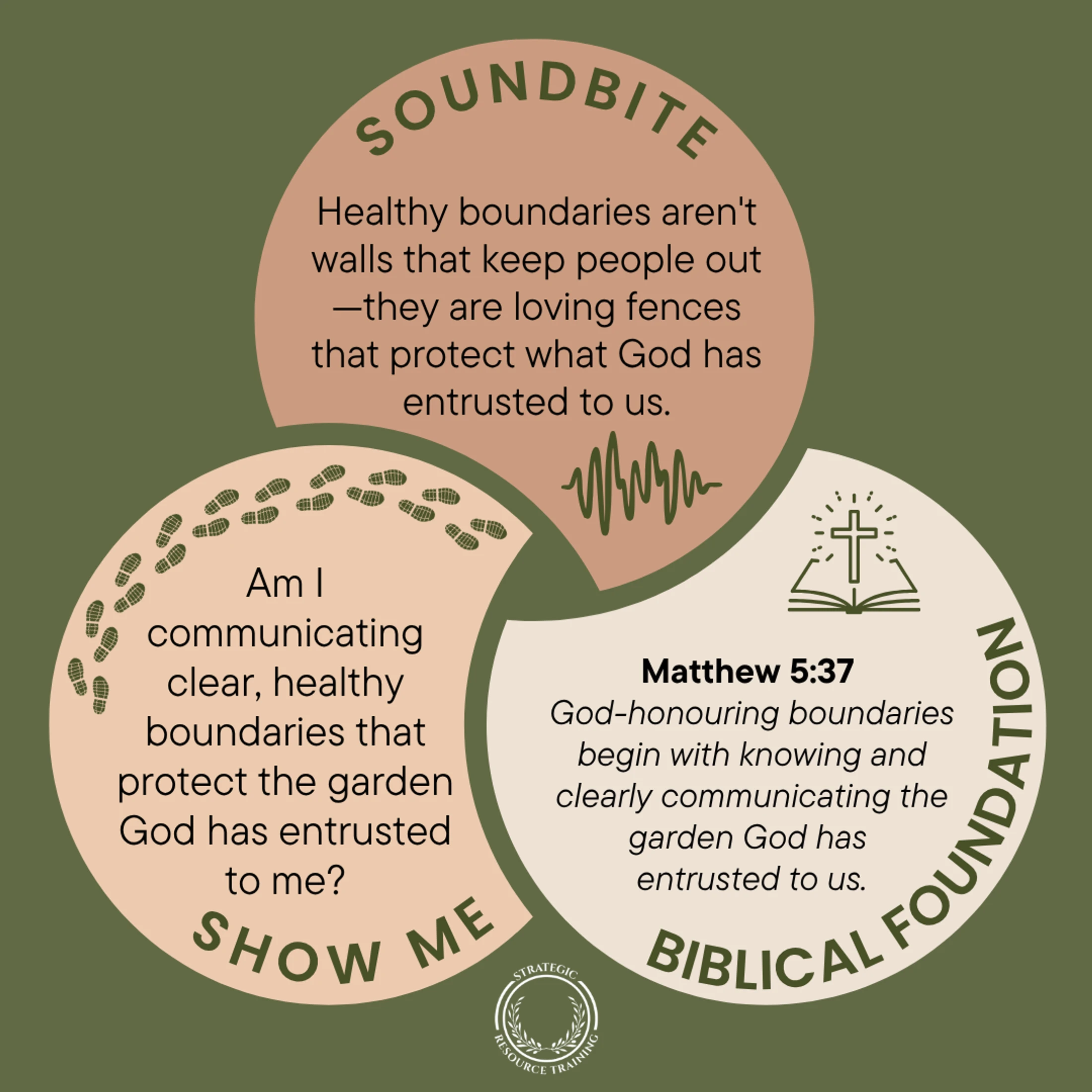
His words establish the perimeter of His boundaries, and ours should do the same. When we communicate clearly, we lovingly let others know where our fences are. Healthy boundaries are not walls that keep people out—they are loving, life-giving fences that protect what God has entrusted to us while allowing healthy relationships to flourish.
God bless you,
Natalie.
God bless you and keep you. Natalie.